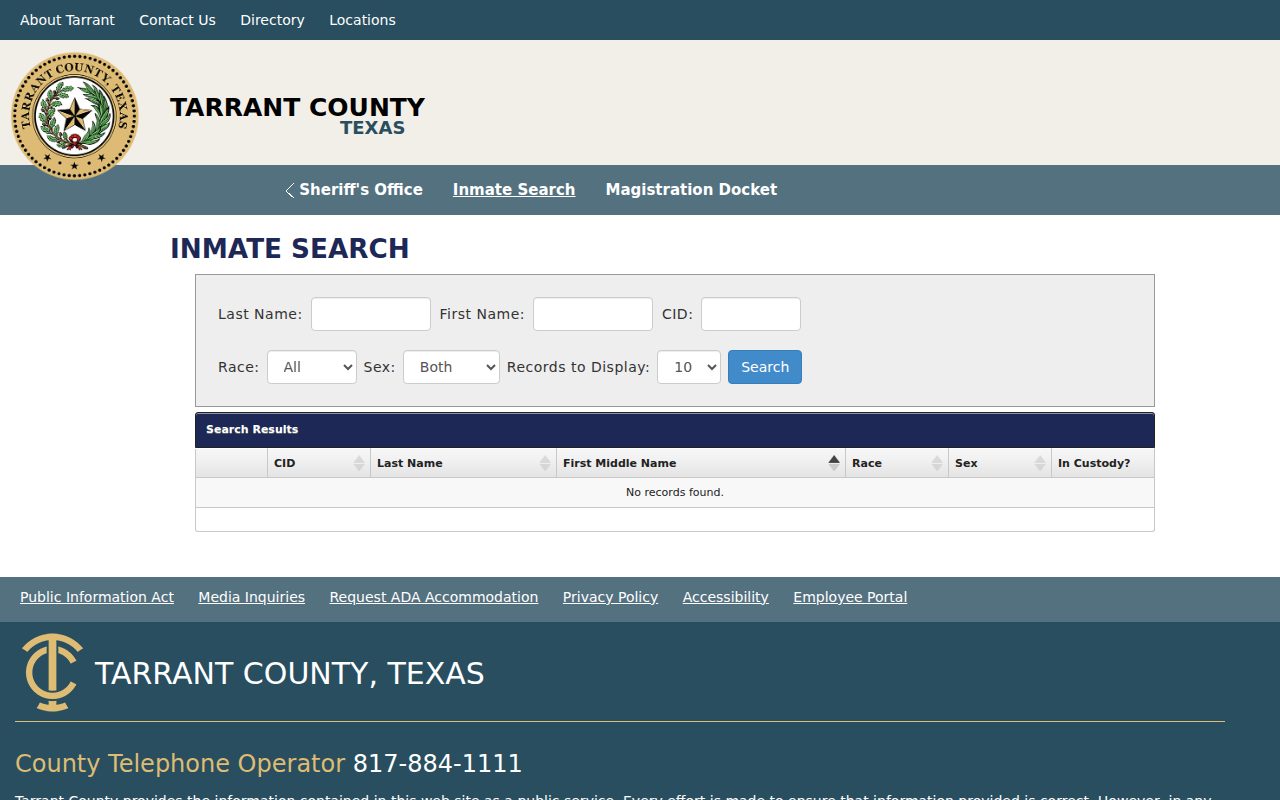
Tarrant County Warrant Search
This guide explains how active warrants are issued and tracked in Tarrant County, Texas, which agencies handle them, and the safe steps someone can take to check for and resolve a warrant. It is informational only and is not legal advice.
How Warrants Work in Tarrant County
A warrant is a court order that authorizes law enforcement to take a specific action, most commonly to arrest a named person or to search a location. In Tarrant County, warrants can originate from several different courts and agencies depending on the underlying matter — a felony or misdemeanor case, a failure to appear, or an unpaid traffic citation. Because these bodies operate separately, there is no single public list that shows every warrant in the county.
The Tarrant County Sheriff's Office maintains a Criminal Warrants Division that tracks and serves criminal warrants. According to the agency, it does not release criminal warrant information to the general public; that information is provided only to licensed bondsmen, attorneys, and law enforcement agencies. The Criminal Warrants Division is listed at 200 Taylor Street – 6th Floor, Fort Worth, TX 76196, phone 817-884-1289. Confirm current procedures directly with that office.
Which Agencies Issue and Track Warrants
Different types of warrants are handled by different offices:
- Felony and misdemeanor warrants: These are generally issued through the district and county criminal courts and tracked by the Sheriff's Office Criminal Warrants Division.
- Justice of the Peace and municipal warrants: Traffic and low-level citation warrants are usually tied to the court shown on the citation. The county notes that traffic-warrant questions should go to the agency that issued the citation, or to the Justice of the Peace shown on the citation.
- Magistrate warrants: Tarrant County operates Magistrate Courts that handle initial appearances and related matters.
Because a single person could have warrants from more than one court, checking one office does not rule out warrants elsewhere. Remember that a warrant or an arrest is not a conviction; it reflects only that a court or officer has authorized an action.
How to Check Whether You Have a Warrant
Since the Sheriff's Office restricts direct release of criminal warrant details to bondsmen, attorneys, and law enforcement, most members of the public rely on other channels:
- Court records search: Tarrant County provides an online public access system (Tyler Odyssey Public Access) where case information may be searched. Case entries can indicate that a warrant has been issued in a matter, though availability and detail vary.
- Contact the issuing court: For a traffic or citation warrant, contact the specific court or Justice of the Peace named on the ticket.
- Hire an attorney: A licensed attorney can obtain warrant information directly and advise you on how to proceed.
If you are unsure which court holds your case, an attorney or the relevant court clerk can help you identify it. Always verify the search steps and what information is shown with the official agency, because online systems do not always reflect every warrant in real time.
Safe Steps to Resolve a Warrant
This section describes general options and is not legal advice. Anyone facing a warrant should strongly consider consulting a licensed attorney before acting.
- Talk to an attorney first. An attorney can confirm the warrant, explain the charge, and discuss options such as posting bond or arranging a surrender.
- Understand bond options. The Sheriff's Office publishes bond information for the Detention Bureau; a licensed bail bond company may also be involved. The Tarrant County Bail Bond Board meets the first Wednesday of every month at 1 p.m. in the Commissioners Courtroom, 100 E. Weatherford St., Fort Worth.
- Address traffic warrants with the correct court. Contact the issuing agency or the Justice of the Peace on the citation to learn your options for clearing it.
- Do not ignore a warrant. An outstanding warrant generally does not expire on its own and can lead to arrest during routine contacts such as a traffic stop.
If you are booked into custody, all inmates are centrally received at the Tarrant County Corrections Center at 100 N. Lamar St., Fort Worth, TX 76196; the main phone is 817-884-3000 and the county telephone operator is 817-884-1111.
Warrants and Related County Records
Warrant activity is one part of a larger criminal-justice records system. Inmate custody status can be checked through the official Tarrant County inmate search, and broader case history is available through the county court records system. According to county data, the Detention Bureau books in approximately 35,000 inmates a year, and the jail has capacity for roughly 5,000 inmates across five facilities. FBI-reported figures — such as the 1,123 arrests reported for 2025 by the primary agency — are historical agency crime statistics, not a live count of who currently has a warrant or is in custody.
Use any records you find for informational purposes only. This information should not be used to make employment, tenant, credit, or insurance decisions.
Frequently Asked Questions
Can I look up my own warrant directly with the Sheriff's Office?
The Sheriff's Office states it does not release criminal warrant information to the general public; it provides that information only to licensed bondsmen, attorneys, and law enforcement agencies. You may be able to see case-level information through the county's court records search, or you can work through an attorney.
Who handles a warrant for an unpaid traffic ticket?
Traffic-warrant questions go to the agency that issued the citation, or to the Justice of the Peace shown on the citation. Contact that court to learn how to resolve it.
How much is bond, and how long does it take to clear a warrant?
Bond amounts, timelines, and procedures are not listed here. You must confirm these details with the issuing court, the Sheriff's Office Detention Bureau, or a licensed attorney, because they vary by case.
Does a warrant mean I have been convicted of a crime?
No. A warrant only authorizes an arrest or another action; it is not a finding of guilt. An arrest is not a conviction.
Official & Public Resources
Sheriff's Office – Criminal Warrants Division
How the Criminal Warrants Division works and who can obtain warrant information (bondsmen, attorneys, law enforcement).
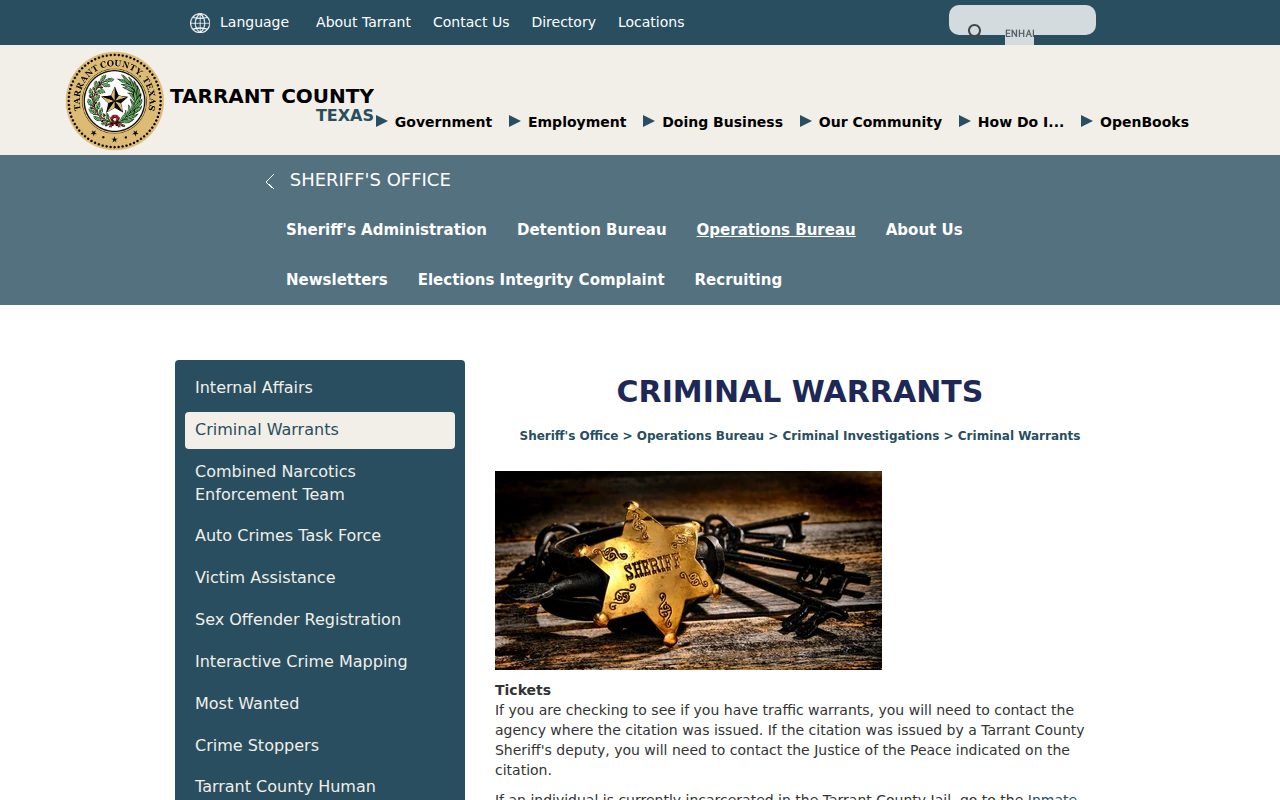
Magistrate Courts
Central magistration where bond is set after arrest.
https://www.tarrantcountytx.gov/en/criminal-courts/magistrate-courts.html
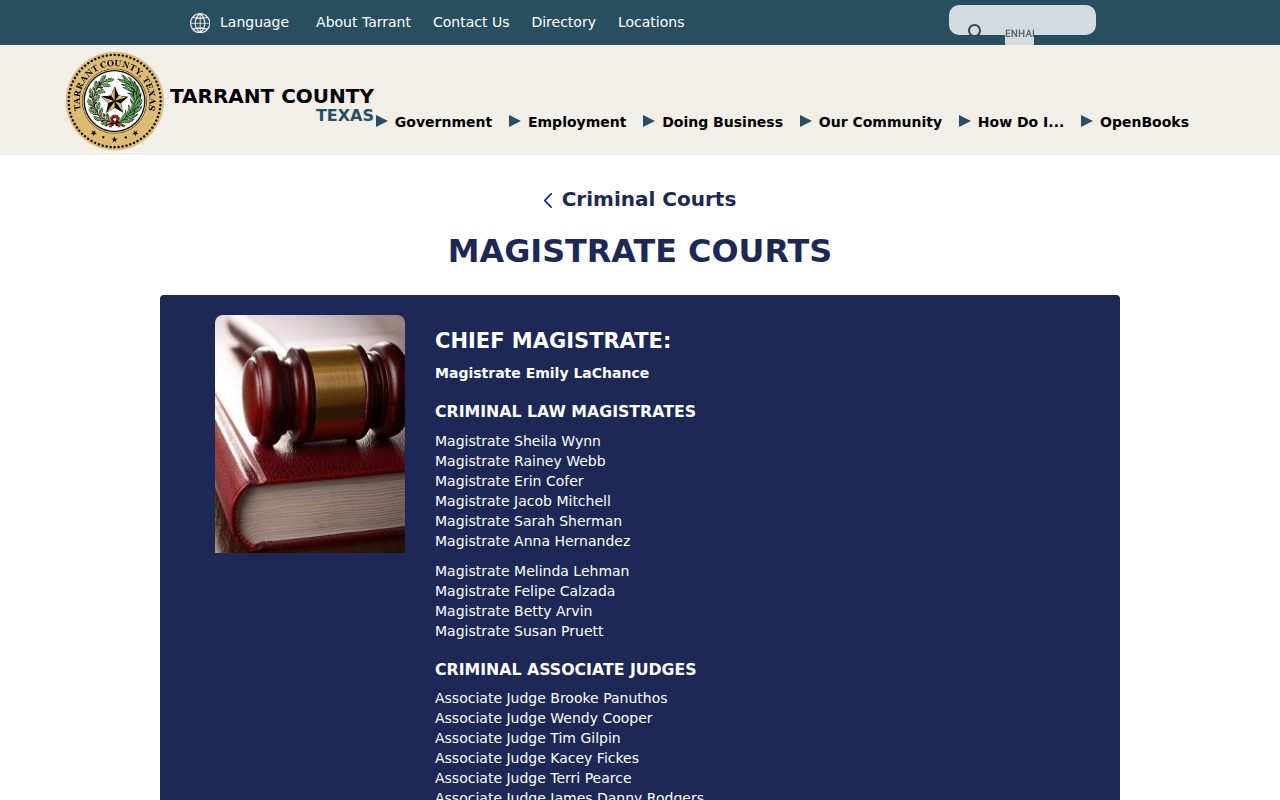
Tarrant County Court Records Search (Tyler Odyssey Public Access)
Check whether a case has been filed against a person.
https://portal-txtarrant.tylertech.cloud/PublicAccess/default.aspx
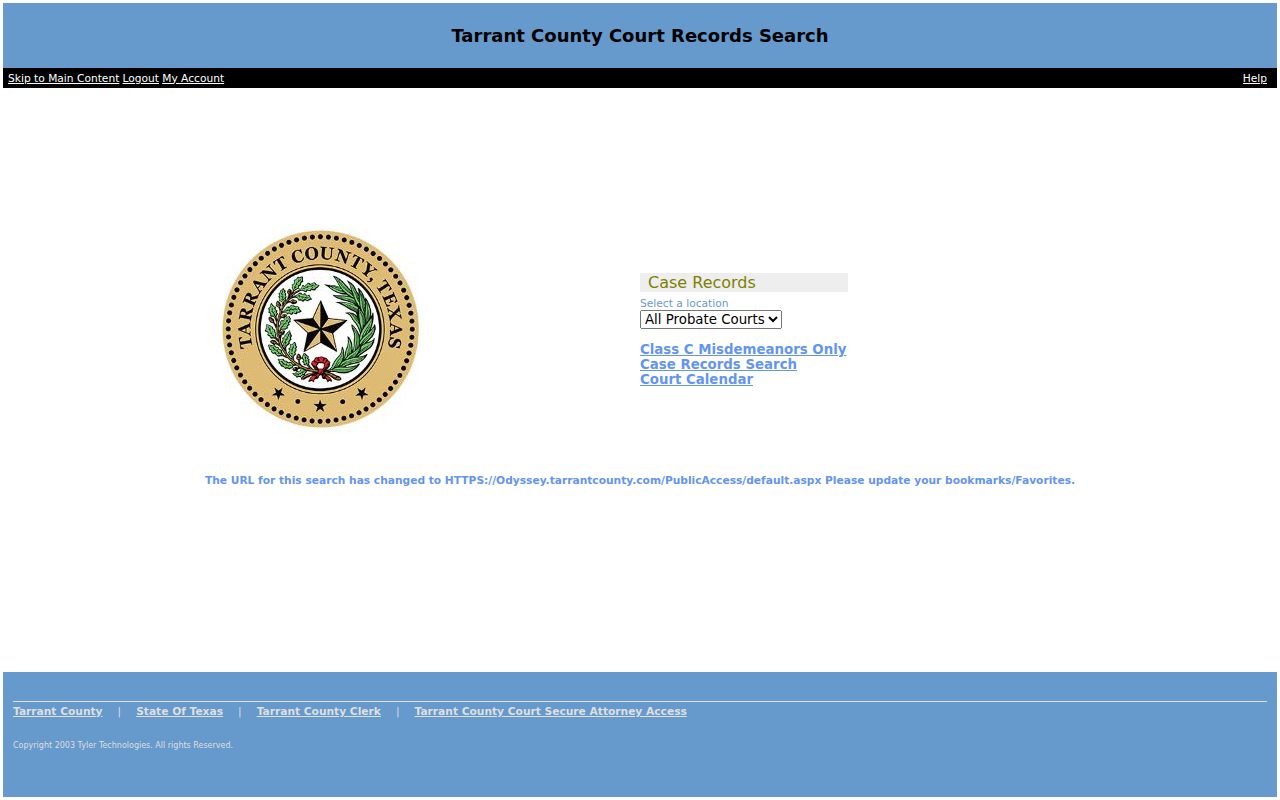
Tarrant County Sheriff's Office
Official Sheriff's Office site: detention bureau, records, warrants and inmate services.
https://www.tarrantcountytx.gov/en/sheriff.html

Tarrant County Inmate Search (official)
Search current Tarrant County Jail inmates by last name, first name or CID.
https://inmatesearch.tarrantcounty.com/